The Names You Don't See in the Credits (But Should): South Asian Professionals Quietly Reshaping Entertainment
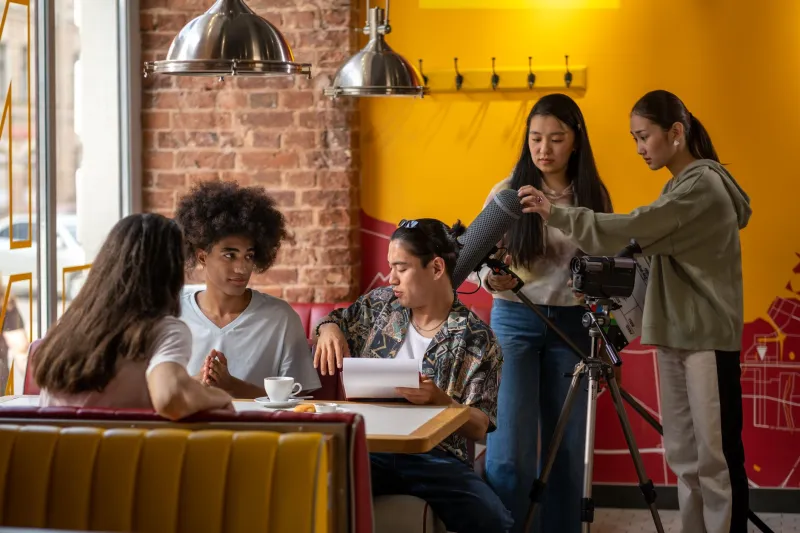
Roll the credits on almost any major film or album release right now, and you'll find them if you know what you're looking for. A surname that traces back to Punjab. A first name that a substitute teacher probably butchered every single year of elementary school. A person who, statistically speaking, had to work twice as hard to get their name in that scroll at all.
The conversation about South Asian visibility in entertainment tends to start and stop at the talent — the actors, the singers, the faces. That's understandable. Representation in front of the camera is important and still genuinely incomplete. But there's an entire parallel story happening in the spaces audiences never see, and it's reshaping the industry from the inside out.
The Infrastructure Nobody Talks About
Hollywood — and the broader American entertainment ecosystem — runs on crew. The director of photography who decides how a scene feels before an actor ever walks into it. The sound designer who makes you feel a film in your chest. The music producer who hears something in a rough demo that nobody else can yet. The choreographer who translates a cultural movement vocabulary into something a global audience experiences as pure electricity.
South Asian professionals have been building quiet careers in all of these roles for decades. What's different now is the density, the visibility within industry circles, and — critically — the mentorship pipelines that are starting to form.
In cities like Los Angeles, New York, and Atlanta, informal networks of South Asian crew members are connecting in ways that would've been nearly impossible twenty years ago. They're sharing job leads, workshopping pitches, and doing something that might be the most radical thing of all: telling each other that they belong in these rooms.
Behind the Camera, in Front of the Change
Consider the world of cinematography. It's a field historically dominated by a pretty narrow slice of humanity — and one where breaking in often depends on mentorship relationships that tend to replicate existing demographics. South Asian DPs working in American film and television have had to navigate that reality with patience and, often, a willingness to take circuitous routes to the work they wanted.
But the paths are opening. Streaming platforms hungry for content — and increasingly aware of the commercial logic of diverse creative voices — have created more opportunities for directors and cinematographers who bring unfamiliar visual sensibilities to familiar genres. A South Asian DP who grew up watching Bollywood films alongside Hollywood blockbusters brings a genuinely different eye to how light, color, and movement tell a story. That's not a niche advantage. It's a creative edge.
The same dynamic plays out in music production. South Asian producers working in hip-hop, R&B, pop, and electronic music are drawing on sonic textures and rhythmic frameworks that Western listeners experience as fresh and propulsive without necessarily being able to name what they're hearing. That's not accidental. It's the sound of a dual cultural inheritance being put to work.
Sound, Silence, and the South Asian Engineer
Audio engineering is one of the most technically demanding and least glamorized roles in entertainment. It's also a field where South Asian professionals are making significant inroads, particularly in the music industry.
The work of a mixing or mastering engineer is, by design, invisible when done well. You're not supposed to hear the engineer — you're supposed to hear the artist. But the engineer's decisions shape everything about how a record lands: the warmth of the low end, the clarity of the vocal, the way a track translates from expensive studio monitors to someone's earbuds on the subway.
South Asian engineers bringing classical music training — whether in Hindustani, Carnatic, or Western traditions — often have an unusually refined ear for harmonic relationships and dynamic range. That training doesn't announce itself. It just makes the work better in ways that are hard to quantify but easy to feel.
Choreography as Cultural Transmission
If there's one behind-the-scenes role where the South Asian influence is becoming harder to ignore, it's choreography. The global explosion of interest in Bollywood-influenced dance — accelerated by social media, K-pop's cross-cultural borrowings, and the sheer kinetic joy of the form — has created real demand for choreographers fluent in those traditions.
South Asian choreographers working in American music videos, award show performances, and commercial campaigns are navigating something genuinely complex: introducing movement vocabularies that carry deep cultural meaning to contexts that may not have the framework to fully receive them. The mudra in a pop video isn't the same as the mudra in a classical Bharatanatyam performance. The translation matters. Getting it right — or getting it wrong — has consequences for both artistic integrity and community trust.
The choreographers doing this work thoughtfully are functioning as cultural translators in the most literal sense. They're making decisions about what to share, how to contextualize it, and where to draw lines — every single day, on sets that often have no one else in the room who understands what those decisions mean.
Mentorship and the Multiplier Effect
Perhaps the most significant development in this space isn't any individual career. It's the growing intentionality around mentorship.
South Asian professionals who broke into crew roles in earlier, less hospitable eras are increasingly making space for the generation behind them. They're advocating for hires, making introductions, and — in some cases — building formal programs to create more structured pathways.
The logic here is straightforward: one South Asian cinematographer in a room changes that room a little. Ten South Asian cinematographers in ten rooms, all of whom got there partly because someone opened a door, changes the industry.
That multiplier effect is already visible if you look at the credits carefully enough. And it's only accelerating.
What the Industry Still Gets Wrong
None of this means the work is done. South Asian crew members still regularly report being mistaken for other departments, having their expertise questioned in ways that their non-South Asian colleagues don't experience, and being passed over for promotions that go to people with less experience and more familiar backgrounds.
The industry's diversity conversations have also tended to focus heavily on on-screen representation while treating below-the-line roles as secondary concerns. That's a mistake — both ethically and strategically. The stories that get told, and how they get told, are shaped as much by the people holding the camera and mixing the sound as by the people in front of the lens.
The South Asian professionals building careers behind the scenes know this. They've always known it. They just haven't always had a platform to say it.
Consider this a start.