Selling Out or Leveling Up? The Real Cost of Going Mainstream as a South Asian Artist
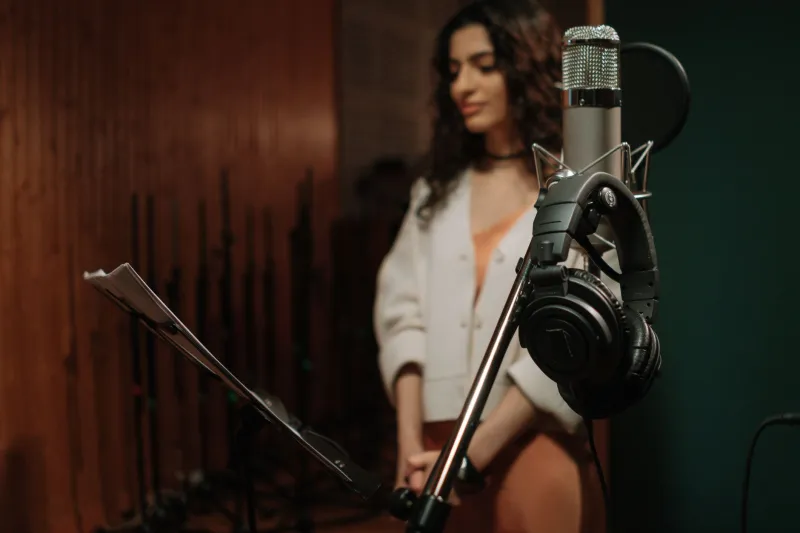
There's a moment almost every South Asian artist in America can describe with painful clarity. It's the moment a label rep, a casting director, or a brand manager looks at them and says some version of: "We love it — can you just make it a little more universal?"
Universal, of course, being a polite word for palatable. Familiar. Safe. Less that.
The tension between staying authentic and scaling reach isn't new in the entertainment industry. But for South Asian creators — people who grew up code-switching between curry-scented kitchens and American school cafeterias — it carries a particular weight. Their cultural identity isn't just aesthetic. It's the whole architecture.
So what actually happens when the spotlight gets bigger? Do you adjust the lights, or do you adjust yourself?
The Myth of the Clean Trade-Off
The popular narrative frames this as binary: you either keep it real and stay niche, or you chase mainstream dollars and lose yourself. But spend any time talking to working South Asian artists and that story falls apart almost immediately.
Take the wave of Desi musicians currently straddling South Asian classical traditions and Western pop production. Artists layering tabla rhythms over trap beats or weaving Carnatic vocal runs into R&B hooks aren't diluting anything — they're expanding the vocabulary. The question isn't whether to adapt. It's how, and who controls the terms.
That distinction matters enormously. An artist who chooses to fuse genres on their own creative terms is doing something fundamentally different from an artist who's been pressured to sand down every cultural edge until the music could've come from anywhere.
One is evolution. The other is erasure.
Strategic Specificity as a Superpower
Here's the counterintuitive thing a lot of emerging South Asian creatives are figuring out: specificity isn't actually the enemy of broad appeal. It might be the engine of it.
Think about what made artists like M.I.A. or A.R. Rahman culturally seismic in Western markets. It wasn't that they softened their South Asian influences to fit in. It was that those influences were so vivid, so particular, so undeniably themselves that mainstream audiences couldn't look away. Novelty built the bridge. Authenticity made people want to cross it.
Younger creators are internalizing this lesson faster than any previous generation. Desi filmmakers are pitching stories set in specific South Asian-American communities — not generic immigrant narratives, but hyper-local, emotionally precise ones — and finding that those stories resonate with Vietnamese-American audiences, Nigerian-American audiences, anyone who's ever had to translate their home life for the outside world.
Specificity, it turns out, is the most universal language there is.
The Compromise Calculus
None of this means the pressure isn't real. It absolutely is.
South Asian artists navigating label deals, streaming algorithms, and Hollywood casting still face structural incentives that push toward homogeneity. Algorithms reward familiarity. Studios greenlight what they can already imagine an audience for. The commercial machinery isn't built to take cultural risks — it's built to minimize them.
So artists make calculations. A singer might keep her Urdu lyrics but agree to a more Western-leaning production style for her debut single, knowing she can push further on album track three. A filmmaker might pitch a story with a South Asian lead but frame it through a genre — thriller, rom-com, horror — that gives distributors a familiar hook. These aren't failures of integrity. They're the chess moves of people who understand the board.
The artists who navigate this most successfully tend to share a few traits. They know exactly which elements of their identity are non-negotiable — the things they will not trade regardless of the opportunity. And they're clear-eyed about which elements are genuinely flexible, places where collaboration and adaptation can make the work richer rather than flatter.
Knowing the difference requires a level of self-awareness that the industry rarely makes space for. But the South Asian artists building real, lasting careers are doing that internal work constantly.
When the Community Becomes the Jury
There's another layer to this that doesn't get talked about enough: the pressure doesn't only come from the industry. It comes from within the community too.
South Asian audiences in the US are not a monolith. First-gen immigrants, second-gen kids, recent arrivals, people who grew up in desi-heavy metros versus those who grew up as the only brown face in their zip code — they all have different ideas about what authentic South Asian representation looks like, and what counts as selling out.
An artist who softens a regional accent for mainstream appeal might get celebrated by some community members as a trailblazer and accused by others of assimilation. A filmmaker who centers a queer South Asian story might be hailed as revolutionary in Brooklyn and quietly boycotted in certain aunty WhatsApp groups.
Navigating that is genuinely hard. And it's a kind of labor — emotional, cultural, relational — that non-South Asian artists simply don't have to do in the same way.
The New Playbook
What's emerging, though, is something genuinely exciting. A growing cohort of South Asian artists in the US is rejecting the false choice entirely and writing new rules.
They're building direct relationships with audiences through social platforms before they ever approach a label or studio — which means they arrive with leverage and a proven fanbase instead of a pitch deck and a prayer. They're forming collectives and creative networks that share resources, amplify each other's work, and provide the kind of cultural context that mainstream industry gatekeepers often lack.
They're also, crucially, getting into positions of power behind the scenes. When the South Asian person in the room isn't just the talent but also the producer, the director, the showrunner — the conversation about authenticity changes entirely. Nobody's asking you to make it more universal when you control the final cut.
The authenticity paradox is real. But it's not unsolvable. The artists figuring it out aren't doing it by finding a perfect balance between two competing forces. They're doing it by refusing to let anyone else define what those forces even are.
That's not a compromise. That's a takeover.